OFFER ID
1641700$8,949
Valid Date Ranges
* This departure has been designated a guaranteed departure by the operator, meaning that the minimum number of guests has been met, although still subject to weather and other conditions.
Prices Start At
Length
Air City
Vacation Rating
Remarks
Prices are per person, based on double occupancy, and subject to availability and change without notice. Prices reflect land only accommodations, airfare is additional. Blackout dates/seasonal supplements may apply. Itinerary and map subject to change. Prices subject to availability and changes without notice. Some restrictions may apply.
All fares are quoted in US Dollars.
OFFER ID
Reference this number when contacting our agency so we may better serve you. Also keeping this number handy will allow you to locate this document again quickly.
Kristiansund
Bronnoysund
Stokmarknes
Sortland
Lulea
Bergen
Trondheim
Harstad
Hammerfest
Kirkenes
Saariselka
Rovaniemi
Stockholm
Explore the Atlantic Road through the middle of the ocean or walk the Fjord Route - a footpath on the very top of Fjord Norway. Whatever you choose to do in Kristiansund, it's sure to take your breath away.
The Atlantic Road is an absolute must see for those vising Kristiansund area. This unique section of road that takes you right out to the ocean’s edge and it is located only 30 mins away from Kristiansund. The road was voted Norway’s ’Engineering Feat of the Century’ and the British newspaper The Guardian called it ‘the world´s best road trip’.
The tour starts with a sightseeing tour of Kristiansund. You will enjoy a beautiful panoramic view of the city from Varden Viewpoint and pass by Vanndammen and Kirkeland church. The church was designed by the architect Odd Østby on the theme "Rock Crystals In Roses ". Consecrated in 1964, this is perhaps Norway's most daring church building: when light flows through the 320 colour glass windows in all shades of red and yellow, the 30-metre high chancel wall is transformed into a symphony of colours.
The tour continues through the modern Atlantic tunnel to Averøy. Along the road you will see agricultural land and small villages on the lush island of Averøy before the landscape becomes more open as we approach the Atlantic Road. Once we get there, we will of course take our time to take photos and admire the dramatic scenery of the coast and the road.
We will also stop at Bud fishing village and see Kvernes stave church from the outside. Kvernes is one of Norway’s youngest stave churches, dating from the 14th century. This church is situated on a hill that offers great views of the Kvernesfjord.
Basis: Private tour.
Duration: 4 hours.
Start / End: City.
Inclusions 1st Class vehicle, English-speaking Guide, Other languages on request.
Not included: entrances and meals.
Physical Activity Level: Grade Easy. Walking required over uneven surfaces.
Tour can operate: afternoon/evening
Wheelchair Accessible: No
Notes: Tour program may be reversed for logistic / planning purposes.
Beautiful Bronnoysund is situated in central Norway. Popular with travellers is a visit to the marvelous Torghatten, a mountain with a distinctive hole running straight through the hillside. Also of interest is the Skarsasen fortress from WWII. Trenches and tunnels lead underground from the four large cannon sites. Fjord Seafood originated here, as well as the largest limestone mine in Northern Europe.
Sortland is a municipality in Nordland County belonging to Norway. Sortland has approximately 9,900 inhabitants currently living in the city. It is now referred to as “The Blue City”, due to a large amount of building around the downtown area being painted blue by its citizens. This destination is known to be one of the best music communities in Norway and has had many local bands that have been very successful in the industry.
Luleå has a variety of cultural institutions to visit including Norrbottens museum, and Norrbotten big band. In January 2007 the Cultural house (Kulturens Hus) was opened, which hosts concerts, and art exhibitions. Shopping, is one of the world's first indoor malls, and Lulea also offers excellent shopping at Strand and Smedjan. The two main shopping streets in the city center are located on Storgatan and Kungsgatan streets.
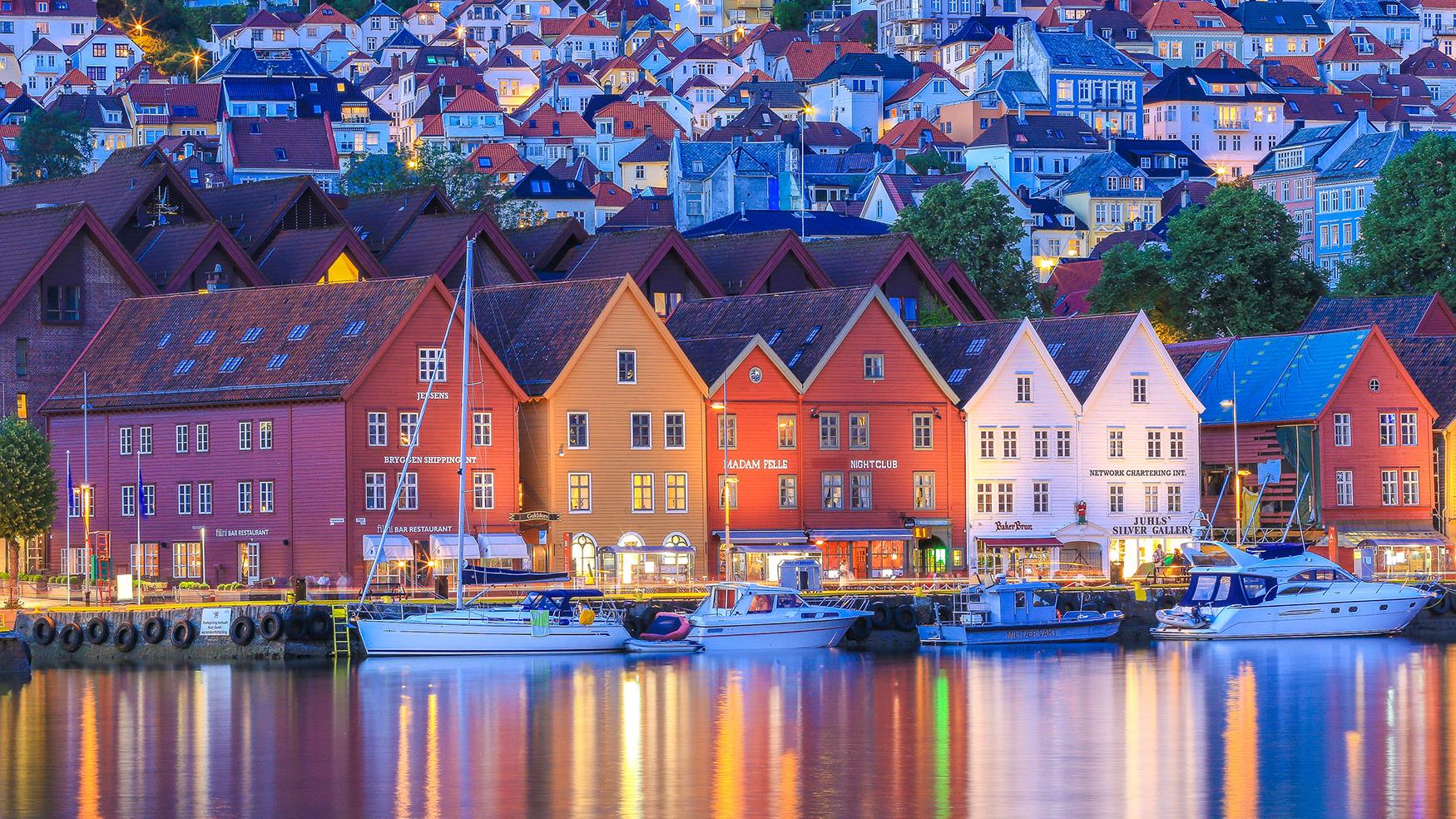
With its spectacular setting among seven hills, Bergen is one of the most beautiful and enjoyable cities in Norway. Most sites are within an easy walk from the harbor. From fine surviving medieval buildings to a series of good museums such as Fishery Museum and Old Bergen open-air museum, Bergen offers a wide variety of attractions. Its scenic beauty can best be appreciated from Mt. Floyen and is captivating. Enjoy this lovely city by taking a stroll to the old part of town, passing impressive 12th-century Bergenhus fortress. Old Hanseatic Wharf, called Bryggen, is where reconstructed gabled buildings house workshops, boutiques and restaurants. St. Mary's Church is Bergen’s oldest building and one of the finest Norman churches in Norway. Rasmus Meyers Collection is a rambling townhouse featuring one of the best collections of Norwegian art, including an upper floor devoted almost entirely to Munch. Bergen boasts numerous historic buildings dating from medieval times: Bergenhus Fortress; Rosenkrantz Tower; Haakon’s Hall.

Bergen may perhaps be a relatively small city (population of 260,000) however it is overflowing with history (the first settlement here were over 900 years ago), culture, incredible nature, gourmet restaurants and cosy cafe’s
Bryggen, the ancient Hanseatic Wharf, which is one of the best known European dwelling places from the Middle Ages, comprises a maze of characteristic wooden buildings with pointed gables facing the harbour.
This unique architectural gem is now listed by UNESCO as one of the world's most significant examples of the history and culture of a medieval settlement. Bryggen thrives today as a honeycomb of painter’s and craftsmen’s workshops, plus access to the interior of some of the buildings themselves where history has been preserved as it was originally.
The Fløibanen funicular in Bergen is one of Norway's best-known attractions. Fløibanen can be found in the heart of Bergen. Fløibanen is a funicular cable car that takes you 320 metres above sea level. In just a few minutes you find yourself on top of a mountain with a perfect view of the city and its surroundings. You have not seen Bergen before you have taken Fløibanen.
| Basis: | Private tour. |
| Duration: | 3 hours. |
| Start / End: | City center Hotel or address. |
| Vehicle: | 01st Class. |
| Guide: | English-speaking. Other languages on request. |
| Entrances: | Fløibanen funicular. |
| Meals: | None. |
| Difficulty: | Grade Easy. Walking required over uneven surfaces. |
| Notes: | Tour program may be reversed for logistic / planning purposes. |
You start this journey by meeting our guide and taking Bergen´s funicular, one of the trademarks of the city.
The funicular railway is one of Norway's most famous attractions. The trip starts in the heart of the city and takes you 320 meters above sea level. In just 6 minutes, you will find yourself on top of Mount Fløyen. After enjoying a panoramic view of Bergen we will start our hike!
Our guide will take you through the beautiful surroundings, enjoying the views of the city, the fjords and mountains while discovering the local nature. You will do this hiking at your own pace.
You may walk down to the city center or take the funicular. The tour ends at Bergen´s Fish Market, a place that has a long history that dates to the 1200s. Since then, the market has been one of the most important places for trade between fishermen, farmers, and the inhabitants of the city. Here you will say goodbye to our guide and enjoy a delicious and traditional Norwegian lunch. You will be served a traditional fish platter that includes local delicacies such as king crab, lobster, langoustines, oysters, and creamy mussels.
Basis: Private hiking/walking tour.
Duration: 5 hours (incl 4 hours for funicular and hike, plus time for lunch on your own).
Start / End: City/Fish Market.
Inclusions: English-speaking guide, Other languages on request, Entrance to Funicular, Lunch at the Fish Market (Luxury platter: King crab, lobster and langoustines in garlic butter, oysters and creamy mussels. Served with salad, bread, aioli and tarragon dip, tap water). Vegetarian option available (Filled spicy portobello mushroom covered in melted local cheese, served on a bed of vegetables and sweet potato purée.)
Not included: Vehicle
Physical Activity Level: Grade Moderate. Walking required over uneven surfaces.
Tour can operate: afternoon/evening
Wheelchair Accessible: No
Notes: Tour program may be reversed for logistic / planning purposes. Bring appropriate clothing and shoes.
You start this walking tour with our guide, visiting two of the main attractions in Bergen for art and design lovers.
We will pay a visit to KODE 3 Museum, which The Rasmus Meyers Collection and a great compilation of works by Edvard Munch, one of the most renowned Norwegian painters.
Among the highlights of the collection are paintings from the Golden Age of Norwegian art, as well as historical interiors from the Bergen area. The presentation includes highlights from the careers of other famous Norwegian artists such as J.C. Dahl, Harriet Backer, Erik Werenskiold and Gerhard Munthe.
We continue our tour by visiting Arven´s workshops. In 1868 Theodor Olsen brought international expertise when he established his own sterling silversmithery and store and quickly became a leader in Bergen’s arts and crafts community. Following his death in 1890, the silver smithery and store continued under the name of Theodore Olsen managed by the Aase family for many generations until 2016 when it became Arven AS. Today, Arven is a modern and innovative factory which is constantly developing new and exciting products through bold design work in cooperation with contemporary designers but preserving traditional techniques and classic design.
During your private visit you will be greeted by your host offering you a special welcome with a drink and a taste of delicious Norwegian local produce cheese and snacks, all served using their beautiful cheese slices and knives we create.
Your visit continues with a presentation about the story of silversmithing in Bergen, about Arven, our history, our products, and our way of working. Afterwards there will time for your questions and participation to “show and tell” how each visitor can make their own stamped pendant!
You are then guided to our workshop and witness where our silver cutlery and jewelries are crafted. There will be a little “ceremony” in the workshop where each visitor gets their own Arven medal.
Basis: Private tour.
Duration: 4 hours walking tour.
Start / End: City.
Vehicle: None.
Guide: English-speaking. Other languages on request.
Entrances: KODE 3 Museum and Arven Silver Factory.
Meals: None.
Physical activity level: Grade Easy. Walking required over uneven surfaces.
Wheelchair accessible: NO
Tour operates: morning, afternoon. Tour not available on Mondays.
Notes: Tour program may be reversed for logistic / planning purposes. The tour is not offered on Sunday and Monday.
During your private visit you will visit Bryggen, which is on UNESCO’s list of world heritage. Your guide will take you through the old part of the city and you will have 5 stops with tastes on your experience. Your also visit the famous Fishmarket including a stop for a sweet surprise.
Bergen is a vibrant port city in the heart of the fjords. The second largest city of the country with 275, 000 inhabitants, it has a long history in international trade in seafood, reflected in its traditional and coastal gastronomy. The city’s food culture originating from sea biodiversity is considered the most sustainable in Europe. Deeply linked to healthy nutrition, gastronomy in Bergen thrives on organic food, the production of which is supported by more than 3,000 farmers and 200 artisan food entrepreneurs. In addition to this, another 6,500 people are employed by the aquaculture industry and fisheries.
Basis: Private tour.
Duration: 3,5 hours walking tour.
Start / End: City.
Vehicle: None.
Guide: English-speaking. Other languages on request.
Entrances: None
Meals: Tastings of local specialties and 1 beer or soft drink
Difficulty: Grade Easy. Walking required over uneven surfaces.
Notes: Tour program may be reversed for logistic / planning purposes. The tour is not offered on Sunday and Monday.
Norway's royal residence since 997 AD, when King Olaf I founded Trondheim, the city still boasts Stiftsgarden, the huge wooden palace. A century later, St. Olaf II began to perform miracles for the people, making Trondheim a major pilgrimage destination. Be sure to visit Nidaros Cathedral, where the Norwegian kings are still crowned, which is certainly one of Europe's premier Gothic-style churches.

This is a tour around Trondheim centre and its outskirts. You'll pass by the main highligts of the city, the old town bridge, the Norwegian University of Science and Technologi (NTNU) at the Kristiansten Fort, the Royal Residence and many more.
The tour continues with a visit to Nidaros Cathedral, the world’s northernmost Gothic cathedral. Built from 1070 over the tomb of St. Olav, the Viking king who brought Christianity to Norway, the cathedral was completed around 1300. In the summer months, you can climb the 172 steps to the top of the tower and be rewarded with an unrivaled view of the city.
You will also visit Trøndelag Open-Air Folk Museum, also known as “Sverresborg”. This is an open air museum with more than 80 historical buildings and several indoor exhibitions. The museum’s old town is comprised of buildings that were originally located in downtown Trondheim, and offers a charming representation of the wooden houses that have dominated the cityscape from the 18th century up until today. The museum’s rural department is located around the ruins of the castle, and consists of farmsteads and houses surrounded by picturesque nature. The houses are all originally from the Trøndelag region. In the rural department you will also find our Sami collection, the Haltdalen stave church, the Lo church and the old school.
| Basis | Private tour |
| Duration | 4 hours |
| Start / End | City center Hotel or address. |
| Vehicle | 1st class. |
| Guide | English-speaking. Other languages on request. |
| Entrances | Nidaros Cathedral and Trøndelag Open-Air Folk Museum |
| Meals | None |
| Difficulty | Grade Easy. Walking required over uneven surfaces. |
The small town of Harstad, 75 miles northwest of Narvik, sits surrounded by craggy, snow-topped mountains on the island of Hinnøya. Harstad’s greatest attraction is the Trondenes Church which dates back to the 13th century. This structure was originally built as a fortress church; its design incorporates massive walls, some 7 1/2 feet thick. At the time, Trondenes was also Norway’s northernmost stone church and one of the most important in the country during Roman Catholic times. As early as the Viking Age the church was used as a local gathering place, including the meetings of the Ting (local parliament). Serving as the breadbasket for northern Norway, this region provides seasonal fruits and vegetables for nearby marketplaces. Harstad’s pretty setting with hilly streets, rainbow-colored wooden houses, terraces and views of the mountains is especially appreciated by the summer crowd which flocks here to enjoy the North Norwegian Arts Festival and International Deep-Sea Fishing Festival, usually held in June and July.
Hammerfest, the world's northern-most city with a population of 7,000 residents, is located in the wide but calm bay of the Province of Finnmark. The North Atlantic Gulf Stream provides the city with an ice free port all year round. Hammerfest's short distance from the North Cape makes it an attractive destination to tourists. Like Tromso, Hammerfest became a major location for the start or end of arctic expeditions in the 19th century. In 1890, the town was one of the first in Europe to provide electric street lighting. Of course, the sun's disappearance from the sky during the arctic winter from November through February may have contributed to this distinction. Today the main street shops of this interesting trawler port offer a friendly welcome, and the drily -named 'Polar Bear Club' provides intriguing insights into Arctic history and tradition.
Saariselka is located in norther Finland, the village is a popular tourist destination with so many activities to offer its guests. The village alone has 350 inhabitants and belongs to the Inari municipality, which has one of the largest Sami communities in Finland. Saariselka is also home to Magnetic Hill, which was an important part of history to the Finns during WWII. One of the experiences most favorited in the area is the light showings of the norther lights, also known as the aurora borealis. Enjoy plenty of activities in the village, such as skiing, dog sledding and don’t forget to visit the reindeer farms.
The town of Rovaniemi boasts many modern buildings that border the unspoiled Lapland countryside and Artic wilderness. There are many great museums to visit as well as excellent hiking and skiing trails. The Ranua Zoo and Santa Park are also great places to visit!
Stockholm is Sweden’s strikingly elegant and beautiful capital. Stockholm, noted for its outstanding architecture, is one of Scandinavia’s most attractive cities. In addition to its many man-made monuments, Stockholm boasts natural beauty - with one-third of the city’s total land area devoted to parks. As the country’s major city, Stockholm offers a wealth of monuments and sites, fine museums, and a rich culture. There are also hundreds of excellent restaurants, as well as a great selection of trendy boutiques and exciting nightclubs. Visitors should start their exploration of Stockholm with the Gamla Stan, the Old Town on Stadsholmen; an island in the center of the city, it has retained its medieval charm. The maze of narrow, cobbled streets, full of art studios, boutiques, antique shops, nightclubs and bars, is best explored on foot.

Drottningholm Palace is on the UNESCO's World Heritage List. It is the best-preserved royal castle built in Sweden during the 1600’s and it is representative of all European architecture that was to follow.
The castle was built by architect Nicodemus Tessin the Elder and was clearly inspired by French architecture and since its construction many royals have left their mark on the palace. Hedvig Eleonora, Lovisa Ulrika and Gustav III left powerful examples of their style, especially in the decor of the reception rooms. Hedvig Eleonora’s state bedchamber was at the heart of their reception rooms in the 1600’s and was created by the country's foremost artists and craftsmen.
There is also a series of rooms that were decorated for Gustav III during the 1700’s which includes the Chinese saloon, a very chic trend at that time.
In 1991 Drottningholm Castle was included on UNESCO's World Heritage list of sites of outstanding universal value to humanity. The Royal family moved into the Drottningholm Palace in 1981 and still today the castle remains the primary residence of the King and Queen. The rooms in the castle's southern section are reserved for the royal couple.
| Basis: | Private tour. |
| Duration: | 4 hours. |
| Start / End: | City center Hotel, address or Pier (excluding Nynäshamn Pier). |
| Vehicle: | 01st Class. |
| Guide: | English-speaking. Other languages on request. |
| Entrances: | Drottingholm Castle. |
| Meals: | None. |
| Difficulty: | Grade Easy. Walking required over uneven surfaces. |
| Notes: | Tour program may be reversed for logistic / planning purposes. |
Sweden’s magnificent capital Stockholm is a city renowned for its characteristic structure, built on 14 islands magnificently bathed by the waters of lake Mälaren. Your tour will introduce you to the most characteristic locations and the most architecturally significant buildings.
You will by visiting the green island of Djurgården with its numerous historic buildings, monuments, museums, galleries, an exciting theme park and a magnificent open-air museum.
While on the island, you will have the opportunity to visit the Vasa Museum. Here you will admire the Swedish warship ‘Vasa’, once considered one of the world’s largest and the pride of Sweden's mighty navy. It was built around the 17th century under the commission of the King of Sweden, Gustav II Adolf, whose aim was to increase the military might of his country. Although the Vasa was expected to be one of the most powerful ships of its time, it was, ironically, not sunk by enemy guns, but by a gust of wind. Even more humiliating for the Swedes was the fact that the Vasa sunk just shortly after it left the harbor of Stockholm on its maiden voyage in full view of the inhabitants of Stockholm who came to watch the spectacle.
Its discovery in 1956 and subsequent salvage in 1961 is one of the most important events in marine archaeology. Painstakingly restored to much of its original magnificence, ‘Vasa’ represents an authentic piece of living history.
Stockholm's Old Town (Gamla Stan) is located on a small island in the very heart of the city. Within its bounds are a multitude of historical sites, including the Royal Palace, the Parliament, the House of Nobilities, as well as the world's longest established bank, the Bank of Sweden that was founded in 1656.
Basis: Private tour.
Duration: 4 hours.
Start / End: City center Hotel, address or Pier (excluding Nynäshamn Pier).
Vehicle: 01st Class.
Guide: English-speaking. Other languages on request.
Entrances: Vasa Museum.
Meals: None.
Difficulty: Grade Easy. Walking required over uneven surfaces.
Notes: Tour program may be reversed for logistic / planning purposes.

Uppsala is located 72 kilometres north of Stockholm and as early as the 6th century it was a political and religious centre.
It was from here that the old pagan kings ruled. Legend has it that there was a splendid temple here that was decorated with gold.
The large historical Uppsala Cathedral was consecrated in 1435. Several famous scientists and kings have their chapels here. There is a fine museum in the north tower full of ecclesiastical textiles and gold and silver objects. In one of the cathedral's chapels lie the holy relics of Sweden's patron saint, St. Erik, in a gold Casket.
Uppsala University is the oldest University in Scandinavia. In the 17th and 18th centuries the university became a centre of research, mainly in the field of natural history. Many are the geniuses that have spread Uppsala's reputation worldwide and to date six Uppsala scientists have received the Nobel prize. The Gustavianum museum is housed in Uppsala University's oldest preserved building. Exhibited at the museum are the Augsburg Art Cabinet, discoveries from the Viking period, the history of the University of Uppsala, mummies and much more.
Sigtuna is a town north of Stockholm that sits beside Lake Mälaren, in the lush landscape of Uppland. The area prospered during the Viking Age, leaving a heritage of rune stones, graves and monuments, which to this day still stand in and around the town. Sigtuna is said to be home to the most rune stones in the world. They were erected during the Viking era to commemorate deceased men.
Sigtuna is Swedens first town and was founded in AD 980, as Christianity arrived, uniting Sweden as a single kingdom. With a royal mint and a bishop, Sigtuna was effectively the capital of Sweden until power shifted towards Stockholm and Uppsala in the 13th century. Three historic church ruins, St. Olof, St. Lars and St. Per, from the 12th and 13th century can be found in the medieval centre of Sigtuna. Here, you will also find the brick Church of Maria, which was built in 1247 as a Dominican monastery.
After three fires in the 17th century, Sigtuna was a ghost town for 250 years but was later revived in the 1910s as a nationalist project. The 18th century Town Hall can be found on Sweden's oldest street, Stora Gatan (over a thousand years old). It is allegedly the smallest town hall in Scandinavia and is nowadays used as a museum. At Stora Gatan, you will also find clusters of interesting little shops selling fashion, design and local handicrafts.
| Basis: | Private tour. |
| Duration: | 6 hours. |
| Start / End: | City center Hotel, address or Pier (excluding Nynäshamn Pier). |
| Vehicle: | 01st Class. |
| Guide: | English-speaking. Other languages on request. |
| Entrances: | Uppsala Cathedral & Gustavianum Museum. |
| Meals: | None. |
| Difficulty: | Grade Easy. Walking required over uneven surfaces. |
| Notes: | Tour program may be reversed for logistic / planning purposes. |

Enjoy the old town of Stockholm with an enjoyable walk through it’s old narrow cobblestoned streets, the beating heart of the historic city that dates back to the 13th century.
Here you will be struck by the contrast between the small characteristic cobbled streets that wind between elegant historic buildings and picturesque squares, and the majestic and imposing Royal Palace that suddenly appears on the horizon.
When exploring these streets, it is easy to imagine that you have travelled back in time to a medieval city. In a constant game of contrasts, we'll investigate the entrance to the narrowest street in Stockholm, just 90 cm wide and with 36 steps, known as Mårten Trotzigs gränd, then visit the fascinating main square of Gamla Stan, as majestic as it is elegant, around which the city was developed back in the 1300s.
A walk through Gamla Stan is not complete without a visit to Stockholm’s Cathedral. Stockholm’s medieval Cathedral, built in 1279, houses unique objects such as the St George and the Dragon sculpture (1489), the legendary Vädersoltavlan (1535) and Lena Lervik’s sculpture ”Joseph and Mary” (2002).
Other points of interest during the tour are Stortorget and the Great Square, the hub of the Old Town which is dominated by the old Stock Exchange, today housing the Nobel Museum and the Swedish Academy.
| Basis | Private tour |
| Duration | 3 hours |
| Start / End | Stockholm city center hotel or address |
| Vehicle | None |
| Guide | English-speaking. Other languages on request. |
| Entrances | Stockholm Cathedral. |
| Meals | none |
| Difficulty | Grade Easy. Walking required over uneven surfaces. |
| Notes | Tour program may be reversed for logistic / planning purposes. |
Sweden’s Jewish community holds a very unique place in the continental European Diaspora. During the mid-20th century, Sweden was one of the only European countries to actually witness a growth in their Jewish population. During the Second World War there was no systematic persecution by the neutral Swedish government, and, in fact, the country gave asylum to thousands of Jewish refugees from Denmark and Norway. The community has continued to exist relatively undisturbed over the generations.
Today, the Swedish Jewish community is the largest in Scandinavia and is primarily composed of descendants of pre-war refugees and Shoah survivors who arrived after the war. Most Swedish Jews live in the capital Stockholm. It is a unified community and all three synagogues in the city belong to the same organization.
Today’s first stop is at the impressive panoramic viewpoint Fjallgatan. Here you can take some photographs while your guide points out the main sights of the city before your scenic drive towards Gamla Stan (Old Town), where you can get an insight into the long-lasting German influence and the many attacks of the Danes during the Middle Ages. Due to the Swedish neutrality nothing has been destroyed here in the last 400 years.
You will then experience the narrow cobblestone streets of the Old Town, passing the Royal Palace and on to Tyska Brunnsplan square, named after the German community that once occupied this area. Here stands the building, which was Stockholm's first synagogue, founded in 1790.
Next stop is the Jewish Museum. Here you will learn about the story of Jewish thought, Jewish practices, and Swedish history deepening your knowledge as far as concerns Jewish history and Swedish-Jewish heritage.
Leaving the Jewish Museum, you pass by the beautiful Jewish cemetery whilst taking in the main sights and highlights of the city.
Basis: Private tour.
Duration: 4 hours.
Start / End: City center Hotel, address or Pier (excluding Nynäshamn Pier).
Vehicle: 01st Class.
Guide: English-speaking. Other languages on request.
Entrances: Jewish Museum. Mondays closed.
Meals: None.
Difficulty: Grade Easy. Walking required over uneven surfaces.
Notes: Tour program may be reversed for logistic / planning purposes.
You start the day by meeting our local guide and taking a 20 minute transfer to the museum.
Millesgåarden was built in 1908 by sculptor Carl Milles and his wife painter Olga Milles. Today, the building became a well-renowned museum with an artist home, an antique collection, a vast sculpture garden, an art gallery with a museum shop and a restaurant. Millesgården is a work of art in its own right, a nicely balanced stage design of terraces, fountains, stairways, sculptures and columns, coupled with a diversity of vegetation and an immense vista across the waters of Värtan from the rocky heights of Herserud.
Once the visit of the museum is over you will go back to the city center in an alternative way: a boat that sails through the archipelago. The ride takes around 1 hour and will end in the city center. Meanwhile, relax and enjoy the stunning views of this nature area.
Basis: Private tour (not available on Mondays).
Duration: 4 hours.
Start / End: City center Hotel, address or Pier (excluding Nynäshamn Pier).
Inclusions: 01st Class vehicle transfer and boat transfer, English-speaking. Other languages on request, Entrance to Millesgården Museum.
Meals: None.
Physical Activity Level: Grade Easy. Walking required over uneven surfaces.
Wheelchair accessible: No.
Tour operates: morning, afternoon. Note: Tour program may be reversed for logistic / planning purposes.

Explore the Atlantic Road through the middle of the ocean or walk the Fjord Route - a footpath on the very top of Fjord Norway. Whatever you choose to do in Kristiansund, it's sure to take your breath away.
The Atlantic Road is an absolute must see for those vising Kristiansund area. This unique section of road that takes you right out to the ocean’s edge and it is located only 30 mins away from Kristiansund. The road was voted Norway’s ’Engineering Feat of the Century’ and the British newspaper The Guardian called it ‘the world´s best road trip’.
The tour starts with a sightseeing tour of Kristiansund. You will enjoy a beautiful panoramic view of the city from Varden Viewpoint and pass by Vanndammen and Kirkeland church. The church was designed by the architect Odd Østby on the theme "Rock Crystals In Roses ". Consecrated in 1964, this is perhaps Norway's most daring church building: when light flows through the 320 colour glass windows in all shades of red and yellow, the 30-metre high chancel wall is transformed into a symphony of colours.
The tour continues through the modern Atlantic tunnel to Averøy. Along the road you will see agricultural land and small villages on the lush island of Averøy before the landscape becomes more open as we approach the Atlantic Road. Once we get there, we will of course take our time to take photos and admire the dramatic scenery of the coast and the road.
We will also stop at Bud fishing village and see Kvernes stave church from the outside. Kvernes is one of Norway’s youngest stave churches, dating from the 14th century. This church is situated on a hill that offers great views of the Kvernesfjord.
Basis: Private tour.
Duration: 4 hours.
Start / End: City.
Inclusions 1st Class vehicle, English-speaking Guide, Other languages on request.
Not included: entrances and meals.
Physical Activity Level: Grade Easy. Walking required over uneven surfaces.
Tour can operate: afternoon/evening
Wheelchair Accessible: No
Notes: Tour program may be reversed for logistic / planning purposes.

Beautiful Bronnoysund is situated in central Norway. Popular with travellers is a visit to the marvelous Torghatten, a mountain with a distinctive hole running straight through the hillside. Also of interest is the Skarsasen fortress from WWII. Trenches and tunnels lead underground from the four large cannon sites. Fjord Seafood originated here, as well as the largest limestone mine in Northern Europe.
Sortland is a municipality in Nordland County belonging to Norway. Sortland has approximately 9,900 inhabitants currently living in the city. It is now referred to as “The Blue City”, due to a large amount of building around the downtown area being painted blue by its citizens. This destination is known to be one of the best music communities in Norway and has had many local bands that have been very successful in the industry.
Luleå has a variety of cultural institutions to visit including Norrbottens museum, and Norrbotten big band. In January 2007 the Cultural house (Kulturens Hus) was opened, which hosts concerts, and art exhibitions. Shopping, is one of the world's first indoor malls, and Lulea also offers excellent shopping at Strand and Smedjan. The two main shopping streets in the city center are located on Storgatan and Kungsgatan streets.
With its spectacular setting among seven hills, Bergen is one of the most beautiful and enjoyable cities in Norway. Most sites are within an easy walk from the harbor. From fine surviving medieval buildings to a series of good museums such as Fishery Museum and Old Bergen open-air museum, Bergen offers a wide variety of attractions. Its scenic beauty can best be appreciated from Mt. Floyen and is captivating. Enjoy this lovely city by taking a stroll to the old part of town, passing impressive 12th-century Bergenhus fortress. Old Hanseatic Wharf, called Bryggen, is where reconstructed gabled buildings house workshops, boutiques and restaurants. St. Mary's Church is Bergen’s oldest building and one of the finest Norman churches in Norway. Rasmus Meyers Collection is a rambling townhouse featuring one of the best collections of Norwegian art, including an upper floor devoted almost entirely to Munch. Bergen boasts numerous historic buildings dating from medieval times: Bergenhus Fortress; Rosenkrantz Tower; Haakon’s Hall.

Bergen may perhaps be a relatively small city (population of 260,000) however it is overflowing with history (the first settlement here were over 900 years ago), culture, incredible nature, gourmet restaurants and cosy cafe’s
Bryggen, the ancient Hanseatic Wharf, which is one of the best known European dwelling places from the Middle Ages, comprises a maze of characteristic wooden buildings with pointed gables facing the harbour.
This unique architectural gem is now listed by UNESCO as one of the world's most significant examples of the history and culture of a medieval settlement. Bryggen thrives today as a honeycomb of painter’s and craftsmen’s workshops, plus access to the interior of some of the buildings themselves where history has been preserved as it was originally.
The Fløibanen funicular in Bergen is one of Norway's best-known attractions. Fløibanen can be found in the heart of Bergen. Fløibanen is a funicular cable car that takes you 320 metres above sea level. In just a few minutes you find yourself on top of a mountain with a perfect view of the city and its surroundings. You have not seen Bergen before you have taken Fløibanen.
| Basis: | Private tour. |
| Duration: | 3 hours. |
| Start / End: | City center Hotel or address. |
| Vehicle: | 01st Class. |
| Guide: | English-speaking. Other languages on request. |
| Entrances: | Fløibanen funicular. |
| Meals: | None. |
| Difficulty: | Grade Easy. Walking required over uneven surfaces. |
| Notes: | Tour program may be reversed for logistic / planning purposes. |

You start this journey by meeting our guide and taking Bergen´s funicular, one of the trademarks of the city.
The funicular railway is one of Norway's most famous attractions. The trip starts in the heart of the city and takes you 320 meters above sea level. In just 6 minutes, you will find yourself on top of Mount Fløyen. After enjoying a panoramic view of Bergen we will start our hike!
Our guide will take you through the beautiful surroundings, enjoying the views of the city, the fjords and mountains while discovering the local nature. You will do this hiking at your own pace.
You may walk down to the city center or take the funicular. The tour ends at Bergen´s Fish Market, a place that has a long history that dates to the 1200s. Since then, the market has been one of the most important places for trade between fishermen, farmers, and the inhabitants of the city. Here you will say goodbye to our guide and enjoy a delicious and traditional Norwegian lunch. You will be served a traditional fish platter that includes local delicacies such as king crab, lobster, langoustines, oysters, and creamy mussels.
Basis: Private hiking/walking tour.
Duration: 5 hours (incl 4 hours for funicular and hike, plus time for lunch on your own).
Start / End: City/Fish Market.
Inclusions: English-speaking guide, Other languages on request, Entrance to Funicular, Lunch at the Fish Market (Luxury platter: King crab, lobster and langoustines in garlic butter, oysters and creamy mussels. Served with salad, bread, aioli and tarragon dip, tap water). Vegetarian option available (Filled spicy portobello mushroom covered in melted local cheese, served on a bed of vegetables and sweet potato purée.)
Not included: Vehicle
Physical Activity Level: Grade Moderate. Walking required over uneven surfaces.
Tour can operate: afternoon/evening
Wheelchair Accessible: No
Notes: Tour program may be reversed for logistic / planning purposes. Bring appropriate clothing and shoes.

You start this walking tour with our guide, visiting two of the main attractions in Bergen for art and design lovers.
We will pay a visit to KODE 3 Museum, which The Rasmus Meyers Collection and a great compilation of works by Edvard Munch, one of the most renowned Norwegian painters.
Among the highlights of the collection are paintings from the Golden Age of Norwegian art, as well as historical interiors from the Bergen area. The presentation includes highlights from the careers of other famous Norwegian artists such as J.C. Dahl, Harriet Backer, Erik Werenskiold and Gerhard Munthe.
We continue our tour by visiting Arven´s workshops. In 1868 Theodor Olsen brought international expertise when he established his own sterling silversmithery and store and quickly became a leader in Bergen’s arts and crafts community. Following his death in 1890, the silver smithery and store continued under the name of Theodore Olsen managed by the Aase family for many generations until 2016 when it became Arven AS. Today, Arven is a modern and innovative factory which is constantly developing new and exciting products through bold design work in cooperation with contemporary designers but preserving traditional techniques and classic design.
During your private visit you will be greeted by your host offering you a special welcome with a drink and a taste of delicious Norwegian local produce cheese and snacks, all served using their beautiful cheese slices and knives we create.
Your visit continues with a presentation about the story of silversmithing in Bergen, about Arven, our history, our products, and our way of working. Afterwards there will time for your questions and participation to “show and tell” how each visitor can make their own stamped pendant!
You are then guided to our workshop and witness where our silver cutlery and jewelries are crafted. There will be a little “ceremony” in the workshop where each visitor gets their own Arven medal.
Basis: Private tour.
Duration: 4 hours walking tour.
Start / End: City.
Vehicle: None.
Guide: English-speaking. Other languages on request.
Entrances: KODE 3 Museum and Arven Silver Factory.
Meals: None.
Physical activity level: Grade Easy. Walking required over uneven surfaces.
Wheelchair accessible: NO
Tour operates: morning, afternoon. Tour not available on Mondays.
Notes: Tour program may be reversed for logistic / planning purposes. The tour is not offered on Sunday and Monday.

During your private visit you will visit Bryggen, which is on UNESCO’s list of world heritage. Your guide will take you through the old part of the city and you will have 5 stops with tastes on your experience. Your also visit the famous Fishmarket including a stop for a sweet surprise.
Bergen is a vibrant port city in the heart of the fjords. The second largest city of the country with 275, 000 inhabitants, it has a long history in international trade in seafood, reflected in its traditional and coastal gastronomy. The city’s food culture originating from sea biodiversity is considered the most sustainable in Europe. Deeply linked to healthy nutrition, gastronomy in Bergen thrives on organic food, the production of which is supported by more than 3,000 farmers and 200 artisan food entrepreneurs. In addition to this, another 6,500 people are employed by the aquaculture industry and fisheries.
Basis: Private tour.
Duration: 3,5 hours walking tour.
Start / End: City.
Vehicle: None.
Guide: English-speaking. Other languages on request.
Entrances: None
Meals: Tastings of local specialties and 1 beer or soft drink
Difficulty: Grade Easy. Walking required over uneven surfaces.
Notes: Tour program may be reversed for logistic / planning purposes. The tour is not offered on Sunday and Monday.
Norway's royal residence since 997 AD, when King Olaf I founded Trondheim, the city still boasts Stiftsgarden, the huge wooden palace. A century later, St. Olaf II began to perform miracles for the people, making Trondheim a major pilgrimage destination. Be sure to visit Nidaros Cathedral, where the Norwegian kings are still crowned, which is certainly one of Europe's premier Gothic-style churches.

This is a tour around Trondheim centre and its outskirts. You'll pass by the main highligts of the city, the old town bridge, the Norwegian University of Science and Technologi (NTNU) at the Kristiansten Fort, the Royal Residence and many more.
The tour continues with a visit to Nidaros Cathedral, the world’s northernmost Gothic cathedral. Built from 1070 over the tomb of St. Olav, the Viking king who brought Christianity to Norway, the cathedral was completed around 1300. In the summer months, you can climb the 172 steps to the top of the tower and be rewarded with an unrivaled view of the city.
You will also visit Trøndelag Open-Air Folk Museum, also known as “Sverresborg”. This is an open air museum with more than 80 historical buildings and several indoor exhibitions. The museum’s old town is comprised of buildings that were originally located in downtown Trondheim, and offers a charming representation of the wooden houses that have dominated the cityscape from the 18th century up until today. The museum’s rural department is located around the ruins of the castle, and consists of farmsteads and houses surrounded by picturesque nature. The houses are all originally from the Trøndelag region. In the rural department you will also find our Sami collection, the Haltdalen stave church, the Lo church and the old school.
| Basis | Private tour |
| Duration | 4 hours |
| Start / End | City center Hotel or address. |
| Vehicle | 1st class. |
| Guide | English-speaking. Other languages on request. |
| Entrances | Nidaros Cathedral and Trøndelag Open-Air Folk Museum |
| Meals | None |
| Difficulty | Grade Easy. Walking required over uneven surfaces. |
The small town of Harstad, 75 miles northwest of Narvik, sits surrounded by craggy, snow-topped mountains on the island of Hinnøya. Harstad’s greatest attraction is the Trondenes Church which dates back to the 13th century. This structure was originally built as a fortress church; its design incorporates massive walls, some 7 1/2 feet thick. At the time, Trondenes was also Norway’s northernmost stone church and one of the most important in the country during Roman Catholic times. As early as the Viking Age the church was used as a local gathering place, including the meetings of the Ting (local parliament). Serving as the breadbasket for northern Norway, this region provides seasonal fruits and vegetables for nearby marketplaces. Harstad’s pretty setting with hilly streets, rainbow-colored wooden houses, terraces and views of the mountains is especially appreciated by the summer crowd which flocks here to enjoy the North Norwegian Arts Festival and International Deep-Sea Fishing Festival, usually held in June and July.
Hammerfest, the world's northern-most city with a population of 7,000 residents, is located in the wide but calm bay of the Province of Finnmark. The North Atlantic Gulf Stream provides the city with an ice free port all year round. Hammerfest's short distance from the North Cape makes it an attractive destination to tourists. Like Tromso, Hammerfest became a major location for the start or end of arctic expeditions in the 19th century. In 1890, the town was one of the first in Europe to provide electric street lighting. Of course, the sun's disappearance from the sky during the arctic winter from November through February may have contributed to this distinction. Today the main street shops of this interesting trawler port offer a friendly welcome, and the drily -named 'Polar Bear Club' provides intriguing insights into Arctic history and tradition.
Saariselka is located in norther Finland, the village is a popular tourist destination with so many activities to offer its guests. The village alone has 350 inhabitants and belongs to the Inari municipality, which has one of the largest Sami communities in Finland. Saariselka is also home to Magnetic Hill, which was an important part of history to the Finns during WWII. One of the experiences most favorited in the area is the light showings of the norther lights, also known as the aurora borealis. Enjoy plenty of activities in the village, such as skiing, dog sledding and don’t forget to visit the reindeer farms.
The town of Rovaniemi boasts many modern buildings that border the unspoiled Lapland countryside and Artic wilderness. There are many great museums to visit as well as excellent hiking and skiing trails. The Ranua Zoo and Santa Park are also great places to visit!
Stockholm is Sweden’s strikingly elegant and beautiful capital. Stockholm, noted for its outstanding architecture, is one of Scandinavia’s most attractive cities. In addition to its many man-made monuments, Stockholm boasts natural beauty - with one-third of the city’s total land area devoted to parks. As the country’s major city, Stockholm offers a wealth of monuments and sites, fine museums, and a rich culture. There are also hundreds of excellent restaurants, as well as a great selection of trendy boutiques and exciting nightclubs. Visitors should start their exploration of Stockholm with the Gamla Stan, the Old Town on Stadsholmen; an island in the center of the city, it has retained its medieval charm. The maze of narrow, cobbled streets, full of art studios, boutiques, antique shops, nightclubs and bars, is best explored on foot.

Drottningholm Palace is on the UNESCO's World Heritage List. It is the best-preserved royal castle built in Sweden during the 1600’s and it is representative of all European architecture that was to follow.
The castle was built by architect Nicodemus Tessin the Elder and was clearly inspired by French architecture and since its construction many royals have left their mark on the palace. Hedvig Eleonora, Lovisa Ulrika and Gustav III left powerful examples of their style, especially in the decor of the reception rooms. Hedvig Eleonora’s state bedchamber was at the heart of their reception rooms in the 1600’s and was created by the country's foremost artists and craftsmen.
There is also a series of rooms that were decorated for Gustav III during the 1700’s which includes the Chinese saloon, a very chic trend at that time.
In 1991 Drottningholm Castle was included on UNESCO's World Heritage list of sites of outstanding universal value to humanity. The Royal family moved into the Drottningholm Palace in 1981 and still today the castle remains the primary residence of the King and Queen. The rooms in the castle's southern section are reserved for the royal couple.
| Basis: | Private tour. |
| Duration: | 4 hours. |
| Start / End: | City center Hotel, address or Pier (excluding Nynäshamn Pier). |
| Vehicle: | 01st Class. |
| Guide: | English-speaking. Other languages on request. |
| Entrances: | Drottingholm Castle. |
| Meals: | None. |
| Difficulty: | Grade Easy. Walking required over uneven surfaces. |
| Notes: | Tour program may be reversed for logistic / planning purposes. |
Sweden’s magnificent capital Stockholm is a city renowned for its characteristic structure, built on 14 islands magnificently bathed by the waters of lake Mälaren. Your tour will introduce you to the most characteristic locations and the most architecturally significant buildings.
You will by visiting the green island of Djurgården with its numerous historic buildings, monuments, museums, galleries, an exciting theme park and a magnificent open-air museum.
While on the island, you will have the opportunity to visit the Vasa Museum. Here you will admire the Swedish warship ‘Vasa’, once considered one of the world’s largest and the pride of Sweden's mighty navy. It was built around the 17th century under the commission of the King of Sweden, Gustav II Adolf, whose aim was to increase the military might of his country. Although the Vasa was expected to be one of the most powerful ships of its time, it was, ironically, not sunk by enemy guns, but by a gust of wind. Even more humiliating for the Swedes was the fact that the Vasa sunk just shortly after it left the harbor of Stockholm on its maiden voyage in full view of the inhabitants of Stockholm who came to watch the spectacle.
Its discovery in 1956 and subsequent salvage in 1961 is one of the most important events in marine archaeology. Painstakingly restored to much of its original magnificence, ‘Vasa’ represents an authentic piece of living history.
Stockholm's Old Town (Gamla Stan) is located on a small island in the very heart of the city. Within its bounds are a multitude of historical sites, including the Royal Palace, the Parliament, the House of Nobilities, as well as the world's longest established bank, the Bank of Sweden that was founded in 1656.
Basis: Private tour.
Duration: 4 hours.
Start / End: City center Hotel, address or Pier (excluding Nynäshamn Pier).
Vehicle: 01st Class.
Guide: English-speaking. Other languages on request.
Entrances: Vasa Museum.
Meals: None.
Difficulty: Grade Easy. Walking required over uneven surfaces.
Notes: Tour program may be reversed for logistic / planning purposes.

Uppsala is located 72 kilometres north of Stockholm and as early as the 6th century it was a political and religious centre.
It was from here that the old pagan kings ruled. Legend has it that there was a splendid temple here that was decorated with gold.
The large historical Uppsala Cathedral was consecrated in 1435. Several famous scientists and kings have their chapels here. There is a fine museum in the north tower full of ecclesiastical textiles and gold and silver objects. In one of the cathedral's chapels lie the holy relics of Sweden's patron saint, St. Erik, in a gold Casket.
Uppsala University is the oldest University in Scandinavia. In the 17th and 18th centuries the university became a centre of research, mainly in the field of natural history. Many are the geniuses that have spread Uppsala's reputation worldwide and to date six Uppsala scientists have received the Nobel prize. The Gustavianum museum is housed in Uppsala University's oldest preserved building. Exhibited at the museum are the Augsburg Art Cabinet, discoveries from the Viking period, the history of the University of Uppsala, mummies and much more.
Sigtuna is a town north of Stockholm that sits beside Lake Mälaren, in the lush landscape of Uppland. The area prospered during the Viking Age, leaving a heritage of rune stones, graves and monuments, which to this day still stand in and around the town. Sigtuna is said to be home to the most rune stones in the world. They were erected during the Viking era to commemorate deceased men.
Sigtuna is Swedens first town and was founded in AD 980, as Christianity arrived, uniting Sweden as a single kingdom. With a royal mint and a bishop, Sigtuna was effectively the capital of Sweden until power shifted towards Stockholm and Uppsala in the 13th century. Three historic church ruins, St. Olof, St. Lars and St. Per, from the 12th and 13th century can be found in the medieval centre of Sigtuna. Here, you will also find the brick Church of Maria, which was built in 1247 as a Dominican monastery.
After three fires in the 17th century, Sigtuna was a ghost town for 250 years but was later revived in the 1910s as a nationalist project. The 18th century Town Hall can be found on Sweden's oldest street, Stora Gatan (over a thousand years old). It is allegedly the smallest town hall in Scandinavia and is nowadays used as a museum. At Stora Gatan, you will also find clusters of interesting little shops selling fashion, design and local handicrafts.
| Basis: | Private tour. |
| Duration: | 6 hours. |
| Start / End: | City center Hotel, address or Pier (excluding Nynäshamn Pier). |
| Vehicle: | 01st Class. |
| Guide: | English-speaking. Other languages on request. |
| Entrances: | Uppsala Cathedral & Gustavianum Museum. |
| Meals: | None. |
| Difficulty: | Grade Easy. Walking required over uneven surfaces. |
| Notes: | Tour program may be reversed for logistic / planning purposes. |

Enjoy the old town of Stockholm with an enjoyable walk through it’s old narrow cobblestoned streets, the beating heart of the historic city that dates back to the 13th century.
Here you will be struck by the contrast between the small characteristic cobbled streets that wind between elegant historic buildings and picturesque squares, and the majestic and imposing Royal Palace that suddenly appears on the horizon.
When exploring these streets, it is easy to imagine that you have travelled back in time to a medieval city. In a constant game of contrasts, we'll investigate the entrance to the narrowest street in Stockholm, just 90 cm wide and with 36 steps, known as Mårten Trotzigs gränd, then visit the fascinating main square of Gamla Stan, as majestic as it is elegant, around which the city was developed back in the 1300s.
A walk through Gamla Stan is not complete without a visit to Stockholm’s Cathedral. Stockholm’s medieval Cathedral, built in 1279, houses unique objects such as the St George and the Dragon sculpture (1489), the legendary Vädersoltavlan (1535) and Lena Lervik’s sculpture ”Joseph and Mary” (2002).
Other points of interest during the tour are Stortorget and the Great Square, the hub of the Old Town which is dominated by the old Stock Exchange, today housing the Nobel Museum and the Swedish Academy.
| Basis | Private tour |
| Duration | 3 hours |
| Start / End | Stockholm city center hotel or address |
| Vehicle | None |
| Guide | English-speaking. Other languages on request. |
| Entrances | Stockholm Cathedral. |
| Meals | none |
| Difficulty | Grade Easy. Walking required over uneven surfaces. |
| Notes | Tour program may be reversed for logistic / planning purposes. |
Sweden’s Jewish community holds a very unique place in the continental European Diaspora. During the mid-20th century, Sweden was one of the only European countries to actually witness a growth in their Jewish population. During the Second World War there was no systematic persecution by the neutral Swedish government, and, in fact, the country gave asylum to thousands of Jewish refugees from Denmark and Norway. The community has continued to exist relatively undisturbed over the generations.
Today, the Swedish Jewish community is the largest in Scandinavia and is primarily composed of descendants of pre-war refugees and Shoah survivors who arrived after the war. Most Swedish Jews live in the capital Stockholm. It is a unified community and all three synagogues in the city belong to the same organization.
Today’s first stop is at the impressive panoramic viewpoint Fjallgatan. Here you can take some photographs while your guide points out the main sights of the city before your scenic drive towards Gamla Stan (Old Town), where you can get an insight into the long-lasting German influence and the many attacks of the Danes during the Middle Ages. Due to the Swedish neutrality nothing has been destroyed here in the last 400 years.
You will then experience the narrow cobblestone streets of the Old Town, passing the Royal Palace and on to Tyska Brunnsplan square, named after the German community that once occupied this area. Here stands the building, which was Stockholm's first synagogue, founded in 1790.
Next stop is the Jewish Museum. Here you will learn about the story of Jewish thought, Jewish practices, and Swedish history deepening your knowledge as far as concerns Jewish history and Swedish-Jewish heritage.
Leaving the Jewish Museum, you pass by the beautiful Jewish cemetery whilst taking in the main sights and highlights of the city.
Basis: Private tour.
Duration: 4 hours.
Start / End: City center Hotel, address or Pier (excluding Nynäshamn Pier).
Vehicle: 01st Class.
Guide: English-speaking. Other languages on request.
Entrances: Jewish Museum. Mondays closed.
Meals: None.
Difficulty: Grade Easy. Walking required over uneven surfaces.
Notes: Tour program may be reversed for logistic / planning purposes.
You start the day by meeting our local guide and taking a 20 minute transfer to the museum.
Millesgåarden was built in 1908 by sculptor Carl Milles and his wife painter Olga Milles. Today, the building became a well-renowned museum with an artist home, an antique collection, a vast sculpture garden, an art gallery with a museum shop and a restaurant. Millesgården is a work of art in its own right, a nicely balanced stage design of terraces, fountains, stairways, sculptures and columns, coupled with a diversity of vegetation and an immense vista across the waters of Värtan from the rocky heights of Herserud.
Once the visit of the museum is over you will go back to the city center in an alternative way: a boat that sails through the archipelago. The ride takes around 1 hour and will end in the city center. Meanwhile, relax and enjoy the stunning views of this nature area.
Basis: Private tour (not available on Mondays).
Duration: 4 hours.
Start / End: City center Hotel, address or Pier (excluding Nynäshamn Pier).
Inclusions: 01st Class vehicle transfer and boat transfer, English-speaking. Other languages on request, Entrance to Millesgården Museum.
Meals: None.
Physical Activity Level: Grade Easy. Walking required over uneven surfaces.
Wheelchair accessible: No.
Tour operates: morning, afternoon. Note: Tour program may be reversed for logistic / planning purposes.